

Bamboo - long-term bone and tendon strength
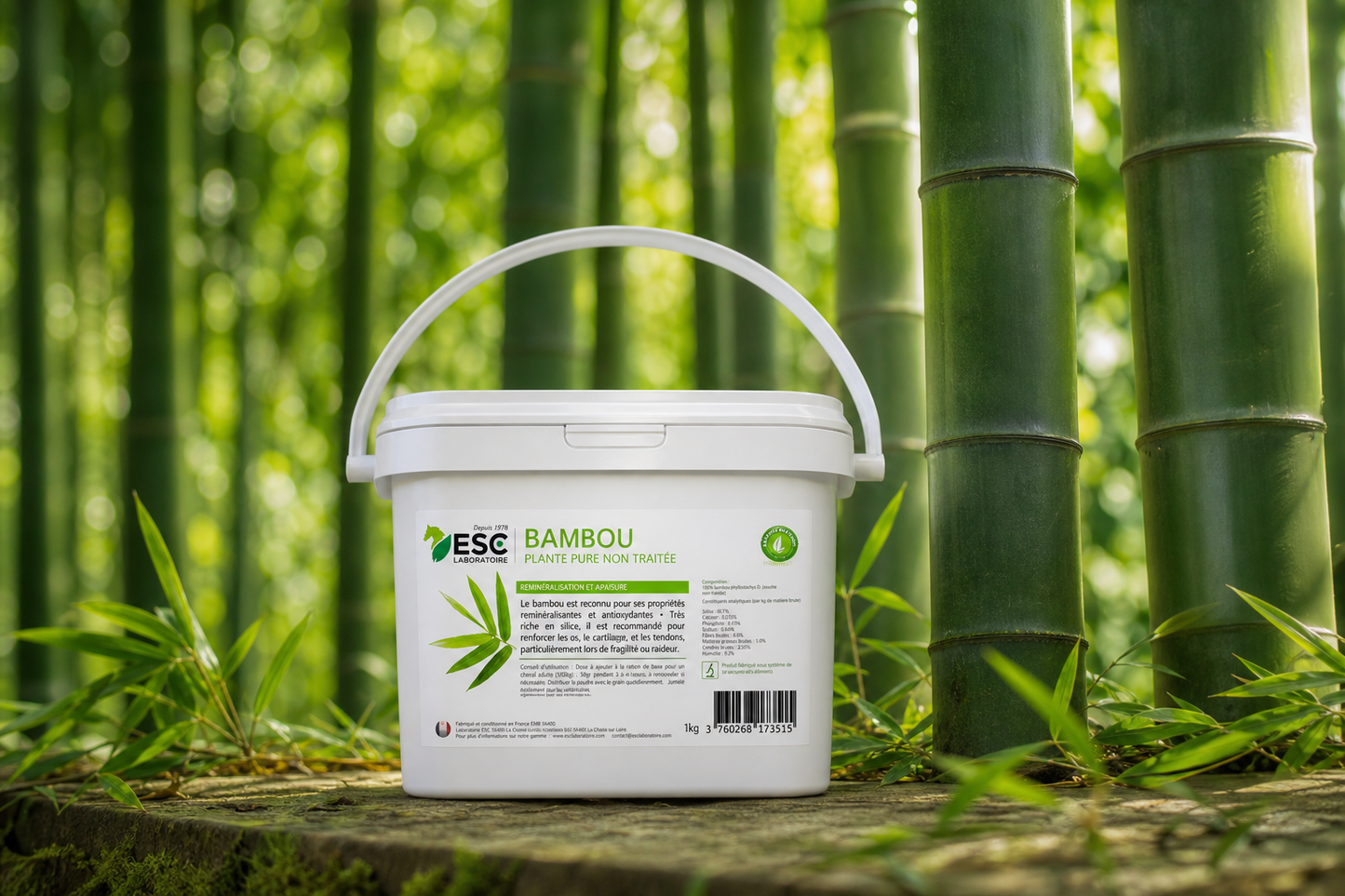
Silica > 55% — Pure dehydrated plant — Certified quality analysis — 1 kg / 40-day course
Bamboo - long-term bone and tendon strength
Couldn't load pickup availability
What if a symbol of flexibility was the key to its resilience?
-
Strengthened bone and tendon structure: bamboo is naturally rich in organic silicon. A key trace element for the remineralization of supporting tissues.
-
Preserved joint flexibility: silicon is involved in the synthesis of collagen and elastin. It thus helps to preserve the elasticity of tendons and the cohesion of cartilages subjected to the repeated stresses of work and age.
-
Long-term fundamental action: this is not a painkiller. It's a structural builder, designed to work deeply on the locomotor "framework."
Offer your horse one of the richest plant sources of silica:
- 100% natural bamboo powder, standardized to over 55% silica
- Selected from a French laboratory expert in premium equine nutrition
- First effects generally visible within 3 to 4 weeks
For which horses?
This bamboo powder is designed for horses that need remineralizing support :
- Seniors who are losing bone density
- Horses with tendon or ligament fragility to support the consolidation of damaged fibers and cartilage support
- Sport horses for fundamental support of the locomotor system's resistance
- Growing young horses to support bone mineralization and connective tissue development
Directions for use (adult horse 550 kg)
Add to the daily basic ration:
25 g per day for 3 weeks. If possible, divide into 2 daily doses. Repeat if necessary.
Do not hesitate to ask your veterinarian for advice before use or extended use.
Recommendations: Pregnant or lactating mares only with veterinary advice.
Storage: store in a cool, dry place. Close tightly after use. Keep out of reach of children.
Anti-doping precaution:
As this product has not been specifically tested to guarantee the absence of natural contaminants likely to cause a positive anti-doping test, we recommend, as a precaution, stopping its administration before an official competition.
official event. Consult your veterinarian for the appropriate withdrawal period for your discipline (usually 72 hours).
Partager
Collapsible content
Composition
Bamboo resin powder for horses.
Analytical constituents: crude protein 0.30%, crude fat 0.35%, crude fiber 0.20%, crude ash 78.70%, moisture content 18.52%.
No additives.
Bacteriological analysis validated by an independent laboratory.
Controlled and packaged in France
To go further (FAQ)
What is Bamboo used for in my horse?
Bamboo is a remineralizing plant exceptionally rich in silica (> 55%). It strengthens bones, cartilage, and tendons by promoting calcium fixation and collagen synthesis. It is particularly recommended in cases of stiffness, bone fragility, or intense training.
How does silica work in the horse's body?
Silica is one of the essential components of connective tissues. It directly contributes to skeletal strength, tendon elasticity, and articular cartilage integrity. Without sufficient silicon, these structures progressively weaken—regardless of calcium intake.
Studies
Nielsen BD, Potter GD et al. (1993)
Training distance to failure in young racing Quarter Horses fed sodium zeolite A Journal of Equine Veterinary Science, 13(10), 562–567.
This pioneering study showed that silicon supplementation increased the training distance to injury in racing Quarter Horses. This is one of the first direct pieces of evidence of silicon's role in bone strength in athletic horses.NCBI
Lang et al. (2001)
Study on yearlings supplemented with silicon vs. control group
Research on young horses has shown a reduction in bone resorption markers (carboxy-terminal telopeptide of type I collagen) in silicon-supplemented horses compared to unsupplemented controls. NCBI
Jugdaohsingh R. (2007)
Silicon and bone health
Journal of Nutrition, Health & Aging, 11(2), 99–110 — PubMed
pubmed.ncbi.nlm.nih.gov/17435952
This review of 30 years of research establishes significant positive associations between dietary silicon intake and bone mineral density, suggesting a beneficial role in bone and connective tissues.
Reffitt DM et al. (2003)
Orthosilicic acid stimulates collagen type 1 synthesis and osteoblastic differentiation in human osteoblast-like cells in vitro
Bone, 32(2), 127–135
High levels of silicon have been found to be strongly linked to connective tissues and their components—glycoaminoglycans, polysaccharides, and mucopolysaccharides—suggesting a fundamental structural role for this trace element.