

Pure marine collagen - direct supply to highly stressed tissues
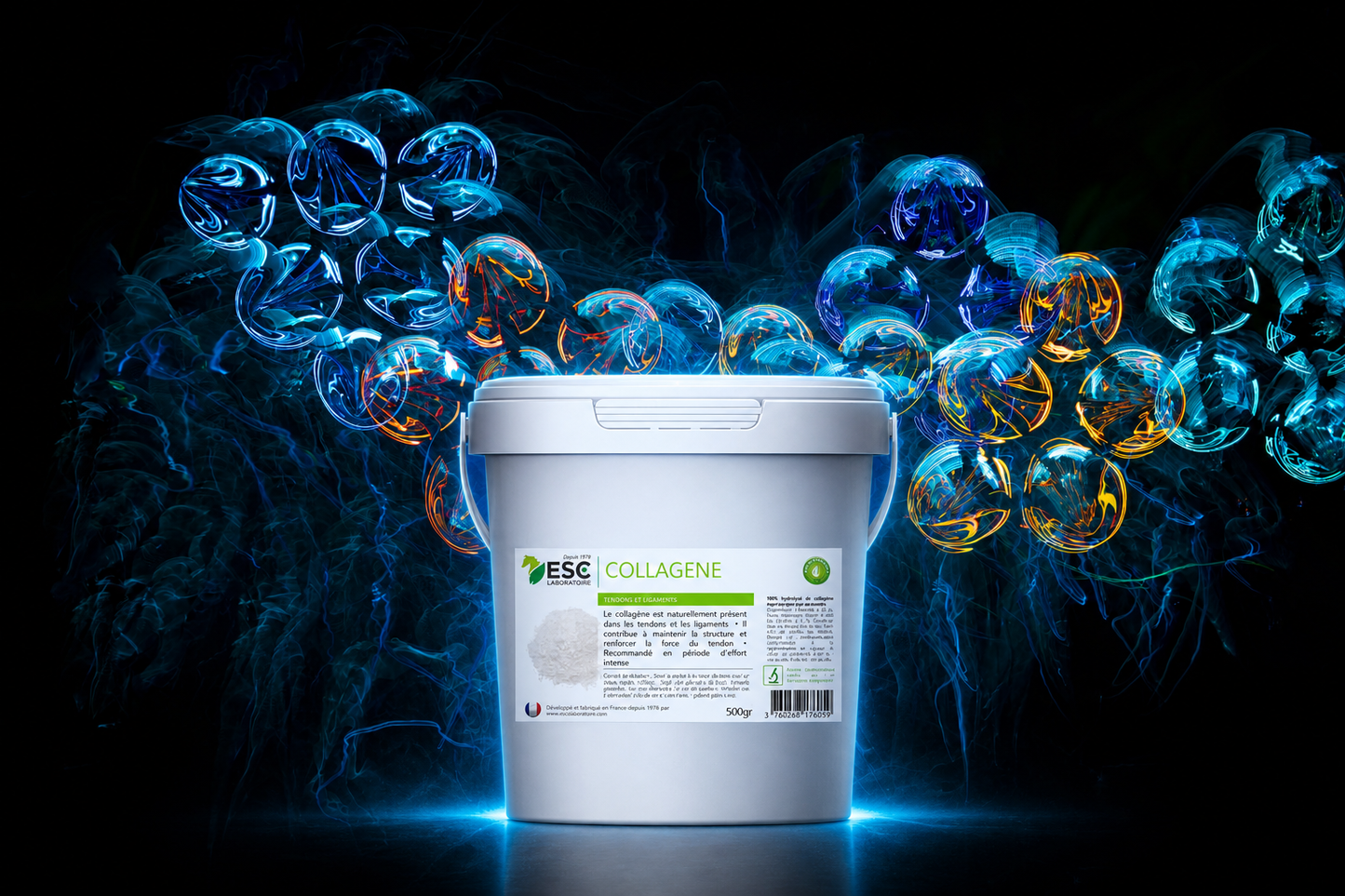
Marine collagen hydrolysate type I — Single ingredient, no additives — Packaged in France — 500 g / 20-day supply
Pure marine collagen - direct supply to highly stressed tissues
Couldn't load pickup availability
Ready-to-use Collagen Peptides
- The structural protein: Type I collagen accounts for 30-35% of the body's total protein. It forms the structural framework of tendons, ligaments, and bones.
- Compensates for deficiency when production slows: With age or intensity of work, degradation exceeds production. Targeted external supplementation rebalances the scales—ideal for recovery after injury, peak load, or for seniors.
- Direct absorption, without loss: In hydrolyzed form with a low molecular weight (4,000 Da), collagen is absorbed and used directly by target tissues—no prior conversion necessary.
For which horses
- Sport horses in season preparation, peak load, or recovery after injury
- Seniors whose natural collagen synthesis decreases with age
- Growing young horses to support the development of a quality bone and tendon framework
Instructions for use (adult horse 550kg):
25 g per day for 3 weeks. Repeat if necessary.
Do not hesitate to ask your veterinarian for advice before use or prolongation.
Recommendations: Pregnant or lactating mares: only on veterinary advice.
Storage: Store in a cool, dry place. Close tightly after use. Keep out of reach of children.
Anti-doping precaution:
As this product has not undergone specific testing to guarantee the absence of natural contaminants likely to result in a positive anti-doping test, we recommend, as a precaution, discontinuing its distribution before an
official event. Consult your veterinarian for the appropriate withdrawal period for your discipline (usually 72 hours).
Partager
Collapsible content
Composition
100% pure marine type I collagen hydrolysate powder.
Analytical constituents: proteins ≥93%, average molecular weight 4000Da, moisture 7%.
To go further (FAQ)
What exactly is type I collagen – and why this type rather than another?
There are several types of collagen in the body. Type I is the most abundant – it makes up tendons, ligaments, bone tissue, and skin. It gives these tissues their mechanical strength and their ability to stretch without tearing. Type II, on the other hand, is found in cartilage. These are two distinct proteins, with distinct roles. This pure marine collagen exclusively provides Type I – the type that tendons and bones need to maintain their framework.
Why marine collagen rather than terrestrial animal collagen?
Marine collagen is hydrolyzed to a very low molecular weight – 4,000 Da – which promotes its absorption by the body. Terrestrial sources (bovine, porcine) generally have higher molecular weights, which can limit their assimilation.
My horse already produces collagen naturally – why supplement?
Yes – up to a certain point. The natural synthesis of collagen decreases with age, and can be exceeded by demand during repeated or intense exertion. When needs exceed production, tissue quality gradually degrades – often without immediate visible signs. Supplementation does not replace natural production: it supports it when it is no longer sufficient.